
ScholarMatic: Explanation & Answer
Your ready answer from a verified tutor is just a click away for as little as $14.99


Click Order Now to get 100% Original Answer Customized to your instructions!
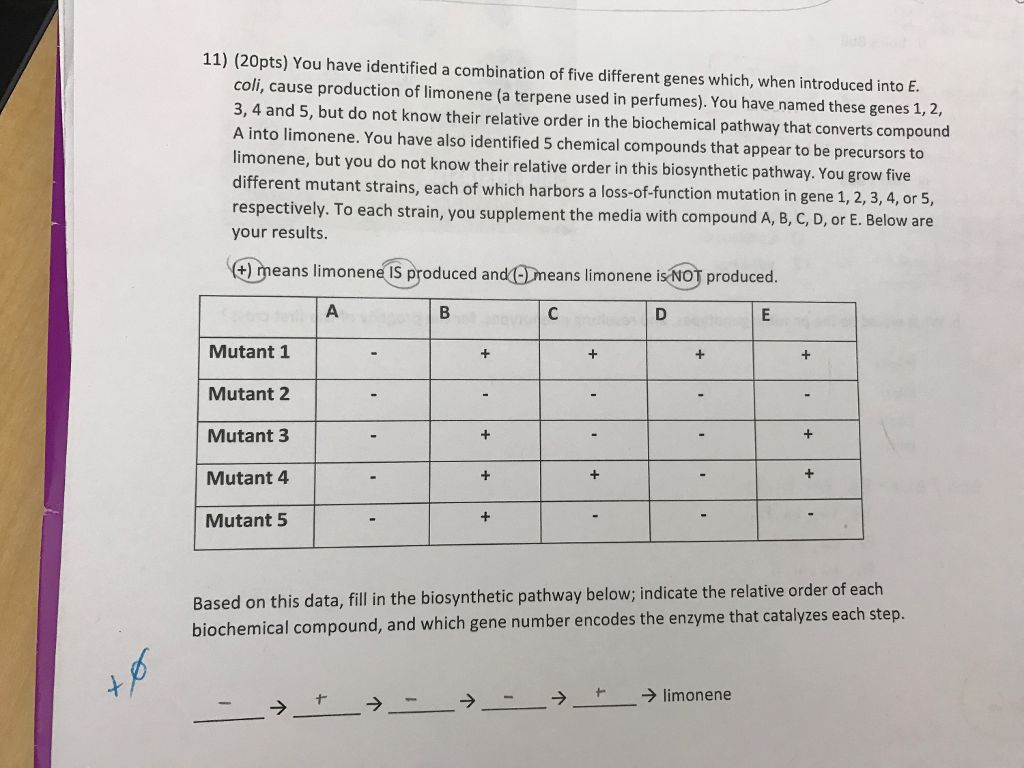
You have identified a combination of five different genes which, when introduced into E. coli, cause production of limonene (a terpene used in perfumes). You have named these genes 1, 2, 3, 4 and 5, but do not know their relative order in the biochemical pathway that converts compound A into limonene. You have also identified 5 chemical compounds that appear to be precursors to limonene, but you do not know their relative order in this biosynthetic pathway. You grow five different mutant strains, each of which harbors a loss-of-function mutation in gene 1, 2, 3, 4, or 5, respectively. To each strain, you supplement the media with compound A, B, C, D, or E. Below are your results. (+) means limonene IS produced and (-) means limonene is NOT produced. Based on this data, fill in the biosynthetic pathway below: indicate the relative order of each biochemical compound, and which gene number encodes the enzyme that catalyzes each step.
ScholarMatic: Explanation & Answer
Your ready answer from a verified tutor is just a click away for as little as $14.99
Click Order Now to get 100% Original Answer Customized to your instructions!