
ScholarMatic: Explanation & Answer
Your ready answer from a verified tutor is just a click away for as little as $14.99


Click Order Now to get 100% Original Answer Customized to your instructions!
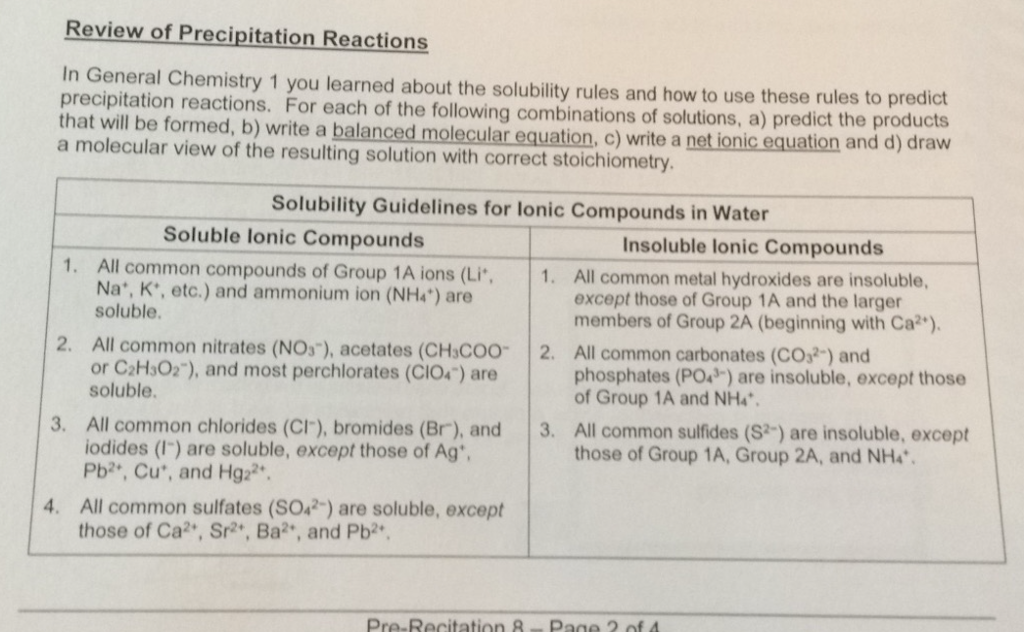
Show transcribed image text Review of Precipitation Reactions In General Chemistry 1 you learned about the solubility rules and how to use these rules to predict precipitation reactions. For each of the following combinations of solutions, a) predict the product that will be formed, b) write a balanced molecular equation, c) write a net ionic equation and a molecular view of the resulting solution with correct stoichiometry. d) draw Solubility Guidelines for lonic Compounds in Water Soluble lonic Compounds Insoluble lonic Compounds 1. All 1. All common metal hydroxides are insoluble, common compounds of Group 1A ions (Li Na', K, etc.) and ammonium ion (NH4") are soluble except those of Group 1A and the larger members of Group 2A (beginning with Ca") 2. All common nitrates (NO,), acetates (CH&COO 2. All common carbonates (co-) and 3. All common chlorides (Cr), bromides (Br), and 3. All common sulfides (S-) are insoluble, except 4. All common sulfates (SO2-) are soluble, except or CaHs02), and most perchlorates (CIOA) are soluble phosphates (PO) are insoluble, except those of Group 1A and NH iodides (I-) are soluble, except those of Ag Pb2, Cu', and Hg2 those of Group 1A, Group 2A, and NH4 those of Ca2, Sr, Ba2, and Pb2 Pre-Recitation 8-Page2 of4
Review of Precipitation Reactions In General Chemistry 1 you learned about the solubility rules and how to use these rules to predict precipitation reactions. For each of the following combinations of solutions, a) predict the product that will be formed, b) write a balanced molecular equation, c) write a net ionic equation and a molecular view of the resulting solution with correct stoichiometry. d) draw Solubility Guidelines for lonic Compounds in Water Soluble lonic Compounds Insoluble lonic Compounds 1. All 1. All common metal hydroxides are insoluble, common compounds of Group 1A ions (Li Na', K, etc.) and ammonium ion (NH4") are soluble except those of Group 1A and the larger members of Group 2A (beginning with Ca") 2. All common nitrates (NO,), acetates (CH&COO 2. All common carbonates (co-) and 3. All common chlorides (Cr), bromides (Br), and 3. All common sulfides (S-) are insoluble, except 4. All common sulfates (SO2-) are soluble, except or CaHs02), and most perchlorates (CIOA) are soluble phosphates (PO) are insoluble, except those of Group 1A and NH iodides (I-) are soluble, except those of Ag Pb2, Cu', and Hg2 those of Group 1A, Group 2A, and NH4 those of Ca2, Sr, Ba2, and Pb2 Pre-Recitation 8-Page2 of4
ScholarMatic: Explanation & Answer
Your ready answer from a verified tutor is just a click away for as little as $14.99
Click Order Now to get 100% Original Answer Customized to your instructions!