
PYSICS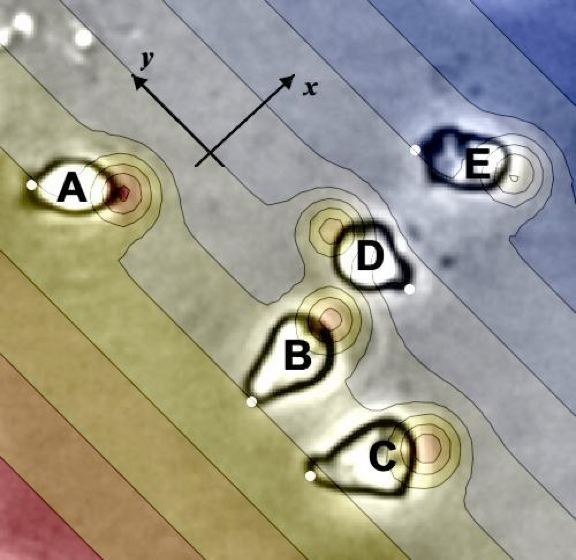
When starving for nutrients, individual slime mold cells get
together to form spores, which are effectively colonies with
thousands of cells. The way the slime mold cells find each other is
by detecting the presence of a tracer chemical that each cell
emits, and essentially moving against the flow of tracer chemicals.
Each cell emits the tracer chemical from one end (the “tail”) and
detects it at the other (the “head”). In the figure at the right is
shown a picture of 5 cells (labeled A through E) on a contour map
of the concentration of the tracer chemical. The white dot on each
cell is the head, where the flow of the chemical is detected. The
amount of concentration of the tracer chemical is shown by a color
code with red being the strongest concentration, then orange, then
yellow, then blue, with dark blue being the lowest
concentration.
A. Consider one of the cells, labeled “A”, which detects a flow
of the tracer chemical. In what direction are the molecules of the
tracer chemical detected by A preferentially moving? (Use the
coordinate system shown to specify your direction.) Explain why you
think so.
B. What is there about the distribution of tracer chemical that
results in a flow in a single direction that the cell can sense?
Don’t the molecules of the tracer chemical move in all directions
equally? Explain.
C. Cells B, C, and D are emitting tracer chemical, but it
doesn’t seem to have reached cell E yet. What would you need to
know in order to estimate the time it would take the tracer
chemical emitted from B, C, and D to diffuse to the location of E
and how might you estimate that time?
ScholarMatic: Explanation & Answer
Your ready answer from a verified tutor is just a click away for as little as $14.99


Click Order Now to get 100% Original Answer Customized to your instructions!