
ScholarMatic: Explanation & Answer
Your ready answer from a verified tutor is just a click away for as little as $14.99


Click Order Now to get 100% Original Answer Customized to your instructions!
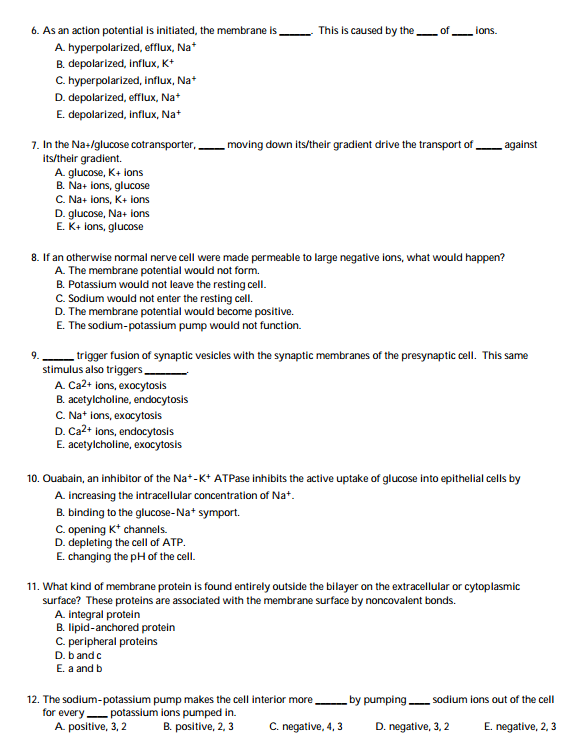
As an action potential is initiated, the membrane is _____. This is caused by the _____ of _____ ions. A. hyperpolarized, efflux, Na^+ B. depolarized, influx, K^+ C. hyperpolarized, influx, Na^+ D. depolarized, efflux, Na^+ E. depolarized, influx, Na^+ In the Na+/glucose cotransporter, _____ moving down its/their gradient drive the transport of _____ against its/their gradient. A. glucose, K^+ ions B. Na^+ ions, glucose C. Na^+ ions, K^+ ions D. glucose, Na^+ ions E. K^+ ions, glucose If an otherwise normal nerve cell were made permeable to large negative ions, what would happen? A. The membrane potential would not form. B. Potassium would not leave the resting cell. C. Sodium would not enter the resting cell. D. The membrane potential would become positive. E. The sodium-potassium pump would not function. _____ trigger fusion of synaptic vesicles with the synaptic membranes of the presynaptic cell. This same stimulus also triggers _____. A. Ca^2+ ions, exocytosis B. acetylcholine, endocytosis C. Na^2 ions, exocytosis D. Ca^2+ ions, endocytosis E. acetylcholine, exocytosis Ouabain, an inhibitor of the Na^+ – K^+ ATPase inhibits the active uptake of glucose into epithelial cells by A. increasing the Intracellular concentration of Na^+. B. binding to the glucose-Na^+ symport. C. opening K^+ channels. D. depleting the cell of ATP. E. changing the pH of the cell. What kind of membrane protein is found entirely outside the bilayer on the extracellular or cytoplasmic surface? These proteins are associated with the membrane surface by noncovalent bonds. A. integral protein B. lipid-anchored protein C. peripheral proteins D. b and c E. a and b The sodium-potassium pump makes the cell interior more _____ by pumping _____ sodium ions out of the cell for every _____ potassium ions pumped in. A. positive, 3, 2 B. positive, 2, 3 C. negative, 4, 3 D. negative, 3, 2 E. negative, 2, 3
ScholarMatic: Explanation & Answer
Your ready answer from a verified tutor is just a click away for as little as $14.99
Click Order Now to get 100% Original Answer Customized to your instructions!