
ScholarMatic: Explanation & Answer
Your ready answer from a verified tutor is just a click away for as little as $14.99


Click Order Now to get 100% Original Answer Customized to your instructions!
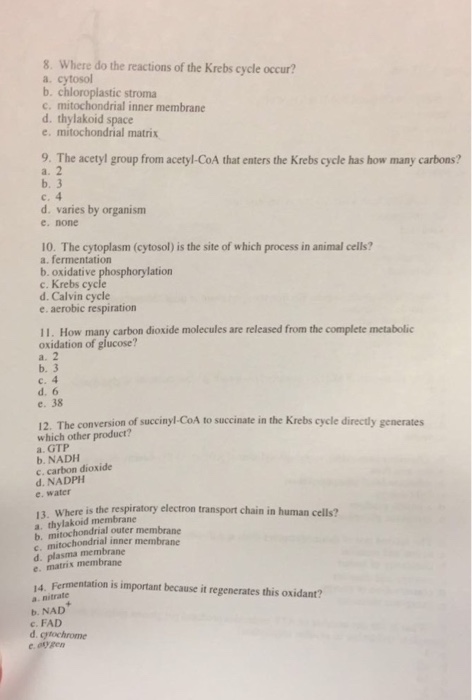
Show transcribed image text 8. Where do the reactions of the Krebs cycle occur? a. cytosol b. chloroplastic stroma c. mitochondrial inner membrane d. thylakoid space e. mitochondrial matrix 9. The acetyl group from acetyl-CoA that enters the Krebs cycle has how many carbons? b. 3 c. 4 d. varies by organism e. none 10. The cytoplasm (cytosol) is the site of which process in animal cells? b. oxidative phosphorylation a. fermentation c. Krebs cycle d. Calvin cycle e. aerobic respiration 11. How many carbon dioxide molecules are released from the complete metabolic oxidation of glucose? a. 2 b. 3 C. d. 6 e. 38 12. The conversion of succinyl-CoA to succinate in the Krebs cycle directly generates which other product? a. GTP b. NADH c. carbon dioxide d. NADPH e. water 13. Where is the respiratory electron transport chain in human cells? a. thylakoid membrane I outer membrane mitochondrial inner membrane d. plasma membrane e. matrix membrane 14. Fermentation is important because it regenerates this oxidant? a nitrate b. NAD c. FAD e. eyen
8. Where do the reactions of the Krebs cycle occur? a. cytosol b. chloroplastic stroma c. mitochondrial inner membrane d. thylakoid space e. mitochondrial matrix 9. The acetyl group from acetyl-CoA that enters the Krebs cycle has how many carbons? b. 3 c. 4 d. varies by organism e. none 10. The cytoplasm (cytosol) is the site of which process in animal cells? b. oxidative phosphorylation a. fermentation c. Krebs cycle d. Calvin cycle e. aerobic respiration 11. How many carbon dioxide molecules are released from the complete metabolic oxidation of glucose? a. 2 b. 3 C. d. 6 e. 38 12. The conversion of succinyl-CoA to succinate in the Krebs cycle directly generates which other product? a. GTP b. NADH c. carbon dioxide d. NADPH e. water 13. Where is the respiratory electron transport chain in human cells? a. thylakoid membrane I outer membrane mitochondrial inner membrane d. plasma membrane e. matrix membrane 14. Fermentation is important because it regenerates this oxidant? a nitrate b. NAD c. FAD e. eyen
ScholarMatic: Explanation & Answer
Your ready answer from a verified tutor is just a click away for as little as $14.99
Click Order Now to get 100% Original Answer Customized to your instructions!