
ScholarMatic: Explanation & Answer
Your ready answer from a verified tutor is just a click away for as little as $14.99


Click Order Now to get 100% Original Answer Customized to your instructions!
Help
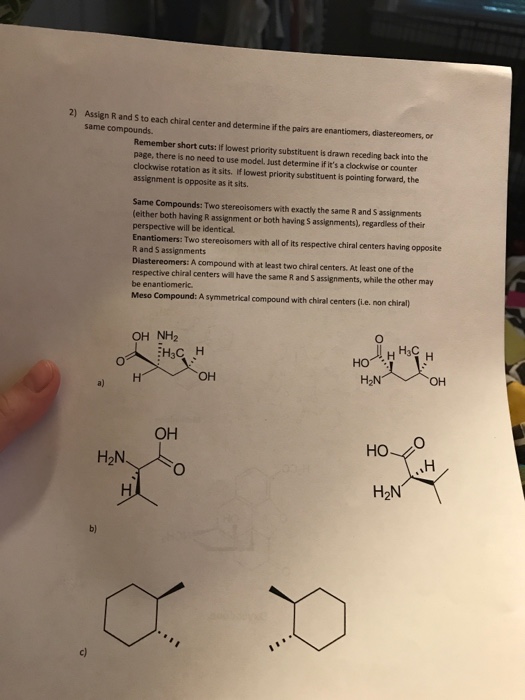
Show transcribed image text 2) Assign R and S to each chiral center and determine if the pairs are enantiomers, diastereomers, or same compounds. Remember short cuts: If lowest priority substituent is drawn receding back into the page, there is no need to use model. Just determine if it's a clockwise or counter clockwise rotation as it sits. If lowest priority substituent is pointing forward, the assignment is opposite as it sits. Same Compounds: Two stereoisomers with exactly the same R and S assignments (either both having R assignment or both having S assignments), regardless of their perspective will be identical. Enantiomers: Two stereoisomers with all of its respective chiral centers having opposite R and 5 assignments Diastereomers: A compound with at least two chiral centers. At least one of the respective chiral centers will have the same R and S assignments, while the other may be enantiomeric Meso Compound: A symmetrical compound with chiral centers (i.e. non chiral) OH NH2 H3C H OH H2N OH OH HO H2N b)
2) Assign R and S to each chiral center and determine if the pairs are enantiomers, diastereomers, or same compounds. Remember short cuts: If lowest priority substituent is drawn receding back into the page, there is no need to use model. Just determine if it's a clockwise or counter clockwise rotation as it sits. If lowest priority substituent is pointing forward, the assignment is opposite as it sits. Same Compounds: Two stereoisomers with exactly the same R and S assignments (either both having R assignment or both having S assignments), regardless of their perspective will be identical. Enantiomers: Two stereoisomers with all of its respective chiral centers having opposite R and 5 assignments Diastereomers: A compound with at least two chiral centers. At least one of the respective chiral centers will have the same R and S assignments, while the other may be enantiomeric Meso Compound: A symmetrical compound with chiral centers (i.e. non chiral) OH NH2 H3C H OH H2N OH OH HO H2N b)
ScholarMatic: Explanation & Answer
Your ready answer from a verified tutor is just a click away for as little as $14.99
Click Order Now to get 100% Original Answer Customized to your instructions!