
ScholarMatic: Explanation & Answer
Your ready answer from a verified tutor is just a click away for as little as $14.99


Click Order Now to get 100% Original Answer Customized to your instructions!
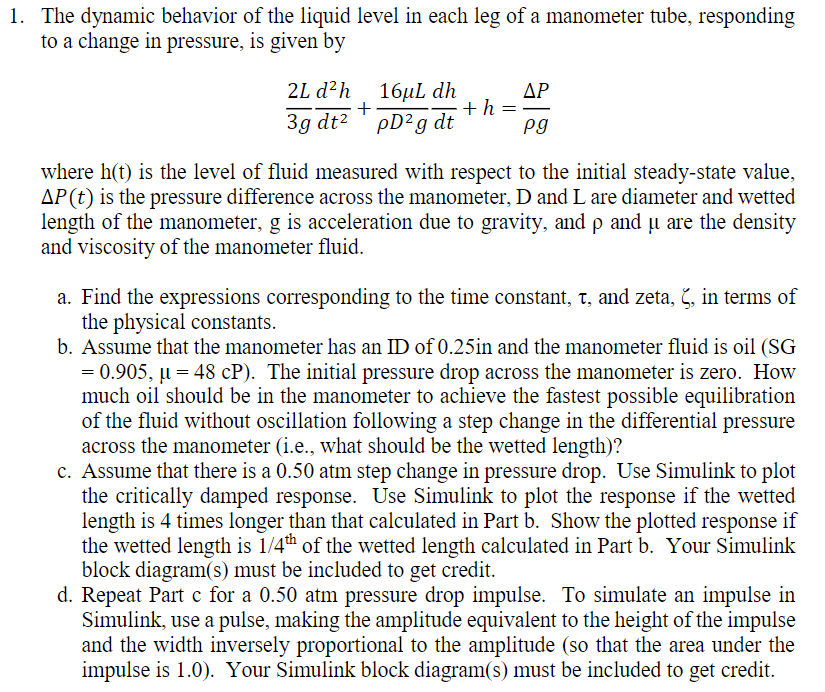
Show transcribed image text 1. The dynamic behavior of the liquid level in each leg of a manometer tube, responding to a change in pressure, is given by where h(t) is the level of fluid measured with respect to the initial steady-state value, P(t) is the pressure difference across the manometer. D and L are diameter and wetted length of the manometer, g is acceleration due to gravity, and ρ and μ are the density and viscosity of the manometer fluid a. Find the expressions corresponding to the time constant, T. and zeta, in terms of the physical constant:s b. Assume that the manometer has an ID of 0.25in and the manometer fluid is oil (SG = 0.905, μ = 48 cP). The initial pressure drop across the manometer is zero. How much oil should be in the manometer to achieve the fastest possible equilibration of the fluid without oscillation following a step change in the differential pressure across the manometer (i.e., what should be the wetted length)? c. Assume that there is a 0.50 atm step change in pressure drop. Use Simulink to plot the critically damped response. Use Simulink to plot the response if the wetted length is 4 times longer than that calculated in Part b. Show the plotted response if the wetted length is 1/4th of the wetted length calculated in Part b. Your Simulink block diagram(s) must be included to get credit d. Repeat Part c for a 0.50 atm pressure drop impulse. To simulate an impulse iin Simulink, use a pulse, making the amplitude equivalent to the height of the impulse and the width inversely proportional to the amplitude (so that the area under the impulse is 1.0). Your Simulink block diagram(s) must be included to get credit.
1. The dynamic behavior of the liquid level in each leg of a manometer tube, responding to a change in pressure, is given by where h(t) is the level of fluid measured with respect to the initial steady-state value, P(t) is the pressure difference across the manometer. D and L are diameter and wetted length of the manometer, g is acceleration due to gravity, and ρ and μ are the density and viscosity of the manometer fluid a. Find the expressions corresponding to the time constant, T. and zeta, in terms of the physical constant:s b. Assume that the manometer has an ID of 0.25in and the manometer fluid is oil (SG = 0.905, μ = 48 cP). The initial pressure drop across the manometer is zero. How much oil should be in the manometer to achieve the fastest possible equilibration of the fluid without oscillation following a step change in the differential pressure across the manometer (i.e., what should be the wetted length)? c. Assume that there is a 0.50 atm step change in pressure drop. Use Simulink to plot the critically damped response. Use Simulink to plot the response if the wetted length is 4 times longer than that calculated in Part b. Show the plotted response if the wetted length is 1/4th of the wetted length calculated in Part b. Your Simulink block diagram(s) must be included to get credit d. Repeat Part c for a 0.50 atm pressure drop impulse. To simulate an impulse iin Simulink, use a pulse, making the amplitude equivalent to the height of the impulse and the width inversely proportional to the amplitude (so that the area under the impulse is 1.0). Your Simulink block diagram(s) must be included to get credit.
ScholarMatic: Explanation & Answer
Your ready answer from a verified tutor is just a click away for as little as $14.99
Click Order Now to get 100% Original Answer Customized to your instructions!