

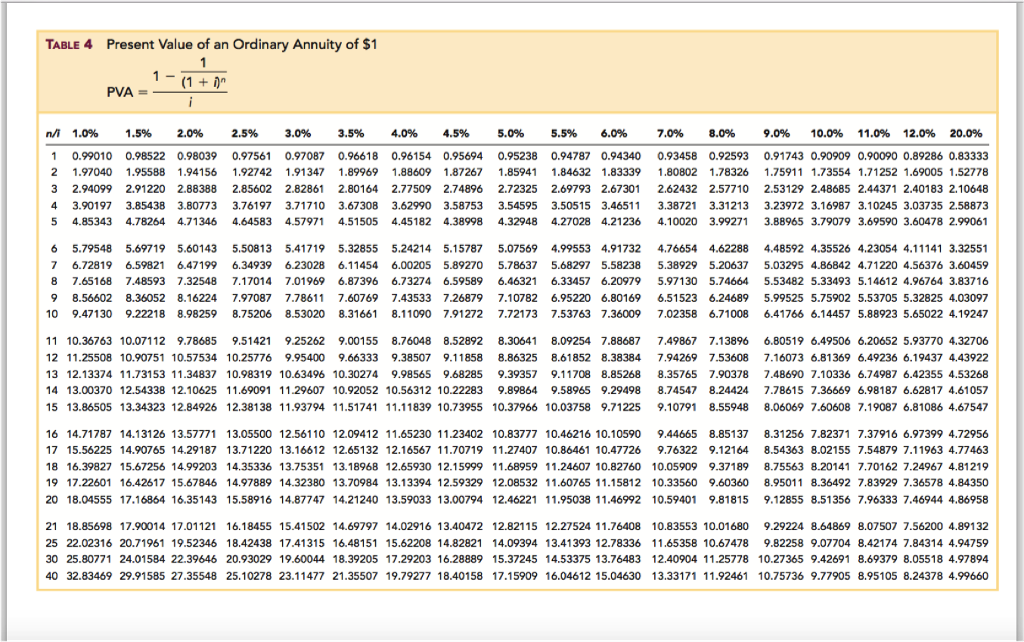
 Note: You MUST use the Time
Value of Money factors (which are provided in the in-class slides)
to complete this assignment. Answers determined using a financial
calculator will not be accepted.
On January 1, 2016, Dudley Company issued $800,000 of five-year,
6% face value bonds that pay interest semi-annually each June 30
and December 31. The bonds were issued to yield an 8% return.
Required:
1. a. Prepare the journal entry to
record the issuance of the bond.
Prepare an amortization table for all years of the bond’s life
to record the amortization of the premium or discount, using the
effective interest method.
Prepare the journal entry for the first two interest payments,
assuming that Dudley uses the effective-interest method to amortize
the premium or discount. (Your figures will come from the
amortization table).
Prepare the journal entry for the first interest payment,
assuming that Dudley uses the straight-line method to
amortize the premium or discount.
Assume that, on December 31, 2018, Dudley redeemed all of the
outstanding bonds at 103. Prepare the journal entries for this
transaction. Use your amortization tables to help you determine the
carrying value of the bond at the time of redemption.
Repeat requirements “1a” through “1d” assuming that the bonds
issued had a stated rate of 10% instead of 6%. (The yield is still
8%).
Looking at your amortization tables for both scenarios, does
your INTEREST EXPENSE increase or decrease each period when you
amortize a discount? What about when you amortize a premium?
Looking at your amortization tables for both scenarios, does
your CARRYING VALUE increase or decrease each period when you
amortize a discount? What about when you amortize a premium?
Looking at your amortization tables for both scenarios, what do
you notice about the AMOUNT OF AMORTIZATION (the difference between
your interest paid and the interest expense) each period? Does it
increase or decrease each period when amortizing a discount? What
about when you are amortizing a premium?
Looking at your amortization table, when amortizing a premium
using the effective interest method, is your interest expense in
the earlier years greater than or less than it is when amortizing
your premium using the straight-line method? What about in later
years?
Looking at your amortization table, when amortizing a discount
using the effective interest method, is your interest expense in
the earlier years greater than or less than it is when amortizing
your discount using the straight-line method? What about in later
years?
ScholarMatic: Explanation & Answer
Your ready answer from a verified tutor is just a click away for as little as $14.99


Click Order Now to get 100% Original Answer Customized to your instructions!