
ScholarMatic: Explanation & Answer
Your ready answer from a verified tutor is just a click away for as little as $14.99


Click Order Now to get 100% Original Answer Customized to your instructions!
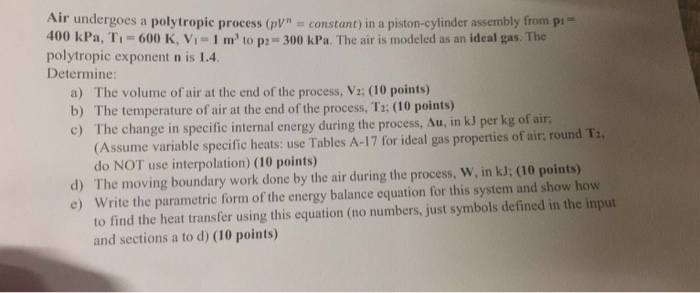
Show transcribed image text Air undergoes a polytropic process (pym = constant) in a piston-cylinder assembly from p,- 400 kPa, Ti -600 K, VI 1 m to p- 300 kPa. The air is modeled as an ideal gas. The polytropic exponent n is 1.4. Determine: a) The volume of air at the end of the process, Vz; (10 points) b) The temperature of air at the end of the process, Tz: (10 points) c) The change in specific internal energy during the process, Au, in kJ per kg of air (Assume variable specific heats: use Tables A-17 for ideal gas properties of air, round T do NO'T use interpolation) (10 points) d) The moving boundary work done by the air during the process, W, in kJ; (10 points) e) Write the parametric form of the energy balance equation for this system and show how to find the heat transfer using this equation (no numbers, just symbols defined in the input and sections a to d) (10 points)
Air undergoes a polytropic process (pym = constant) in a piston-cylinder assembly from p,- 400 kPa, Ti -600 K, VI 1 m to p- 300 kPa. The air is modeled as an ideal gas. The polytropic exponent n is 1.4. Determine: a) The volume of air at the end of the process, Vz; (10 points) b) The temperature of air at the end of the process, Tz: (10 points) c) The change in specific internal energy during the process, Au, in kJ per kg of air (Assume variable specific heats: use Tables A-17 for ideal gas properties of air, round T do NO'T use interpolation) (10 points) d) The moving boundary work done by the air during the process, W, in kJ; (10 points) e) Write the parametric form of the energy balance equation for this system and show how to find the heat transfer using this equation (no numbers, just symbols defined in the input and sections a to d) (10 points)
ScholarMatic: Explanation & Answer
Your ready answer from a verified tutor is just a click away for as little as $14.99
Click Order Now to get 100% Original Answer Customized to your instructions!